

CHIESA DI SANTA MARIA DEL CARMINE – PISA
Consolidation and Conservative Restoration of the Church of Santa Maria del Carmine
CLIENT:
DIRETTORE DEI LAVORI:
ACTIVITIES CARRIED OUT:
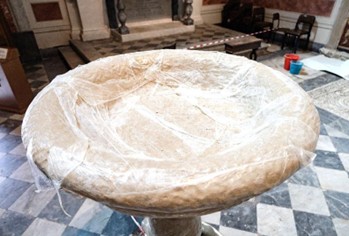
Since the stone elements featured a similar material composition and were exposed to identical types of degradation and environmental conditions, a uniform restoration methodology was selected for most of the components. Nevertheless, as per standard practice, cleaning tests were conducted in each individual case to determine appropriate poultice contact times, in full coordination and prior agreement with the Works Management (D.L.).
Every phase of the intervention—before, during, and after—was photographically documented, both in general and in detail. The work proceeded with the following operations:
- Stabilization: Verification of the stability of old integrations, grouting, or unstable elements, and removal of those at risk of falling.
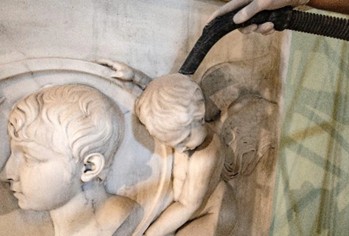
- Cleaning: Removal of loose surface deposits by dusting with soft-bristle brushes and vacuum suction.
- Metal Treatment: Brushing of metal elements, application of a 3% alcoholic solution of tannic acid, and application of a 15% Paraloid protective film.
- Cleaning Trials: Testing involved washing with demineralized water and soft brushes, followed by poultices of demineralized water (80% Arbocel, 20% Sepiolite) and ammonium carbonate (15% aqueous solution). Contact times were tested at 30, 60, 120, and 240 minutes, followed by thorough rinsing. The 120 and 240-minute ammonium carbonate poultices proved most effective for the required cleaning level.
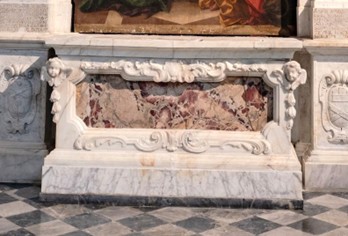
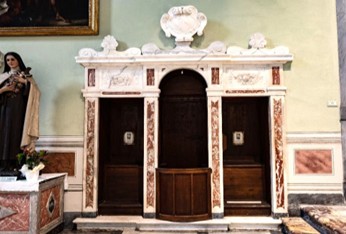
- Specialized Removal: Wax spatters on altar tables, column pedestals, and the lower third of confessionals were removed mechanically with scalpels and white spirit swabs. Bitumen splashes (likely from past roof repairs) were removed using benzyl alcohol swabs.
- Structural Consolidation: Bonding of unstable or fractured elements using EPO 121 two-component epoxy resin. The volutes of one confessional were secured using Mapei P9 single-component resin.
- Grouting: Deep grouting of joints and fractures using a lime putty and sand mortar (1:2 ratio). Finish grouting used a mortar of lime putty and straw-white marble dust (1:2 ratio).
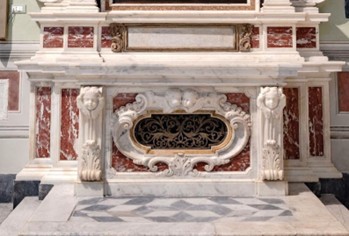
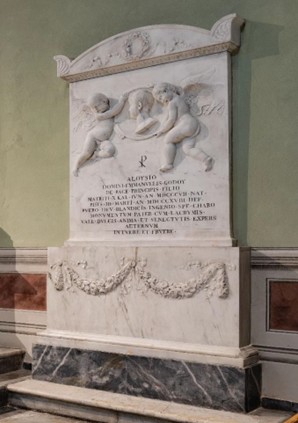
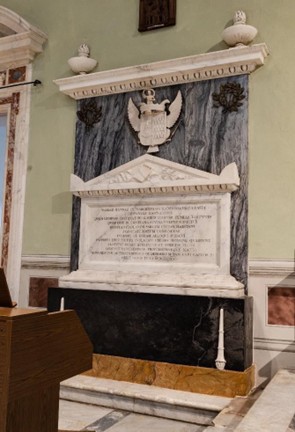
- Aesthetic Integration: Restoration of inscriptions on altars and plaques using ammonium caseinate and natural pigments. The “faux gold” on the acroterion trigrams was reintegrated using MICA gold and gum arabic. New grouting was color-matched using lime wash and natural pigments.
- Protection: Application of FATA protective wax to stone surfaces, polished with a cotton cloth.
SOGGETTO:
STATE OF CONSERVATION:
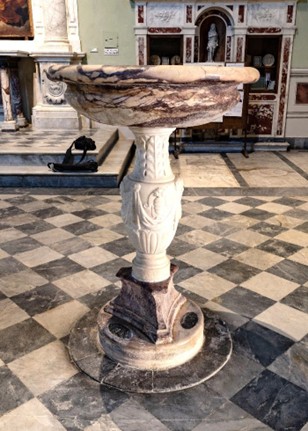
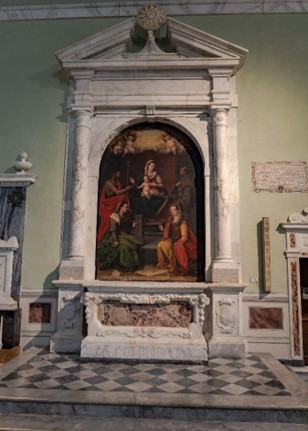
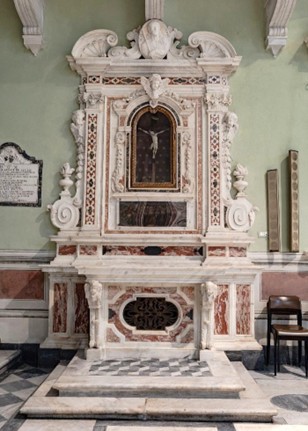
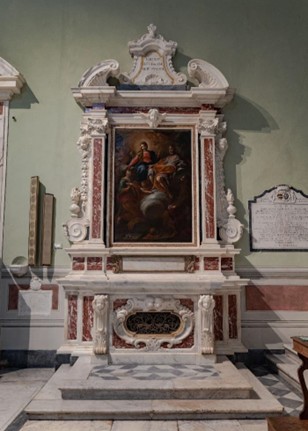
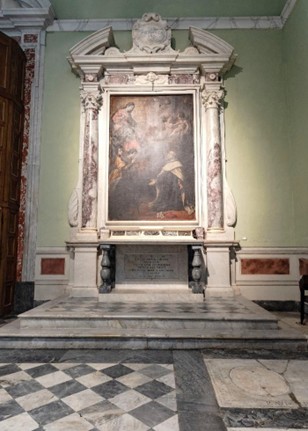
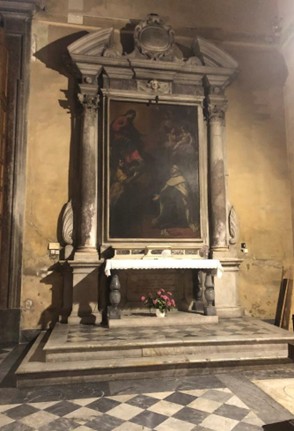
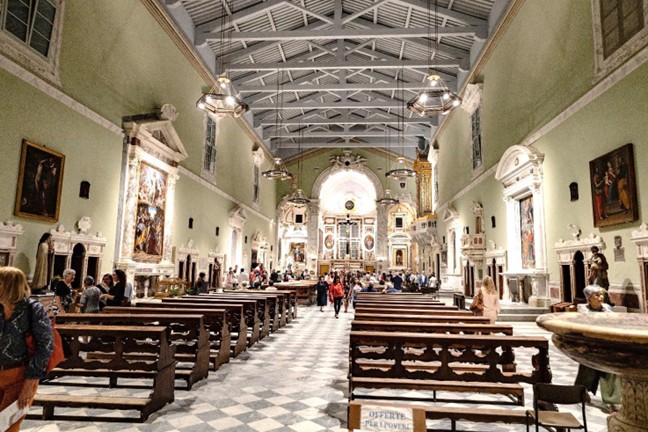
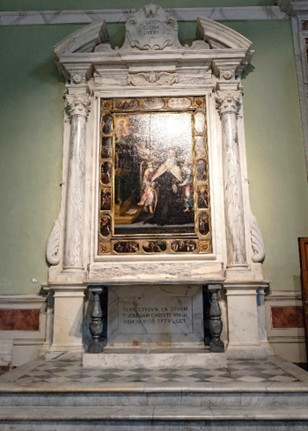
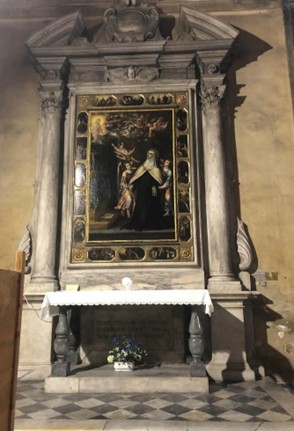
The decorative apparatus—comprising white and polychrome marble altars, internal portals, inlaid marble confessionals, and stone furnishings such as holy water fonts, plaques, and commemorative monuments—exhibits a poor state of conservation. Various types of degradation are present across the different stone surfaces, including:
- Missing parts and material disintegration;
- Coherent and incoherent surface deposits;
- Calcareous concretions and differential weathering;
- Chromatic alterations and staining;
- Fracturing and cracking.